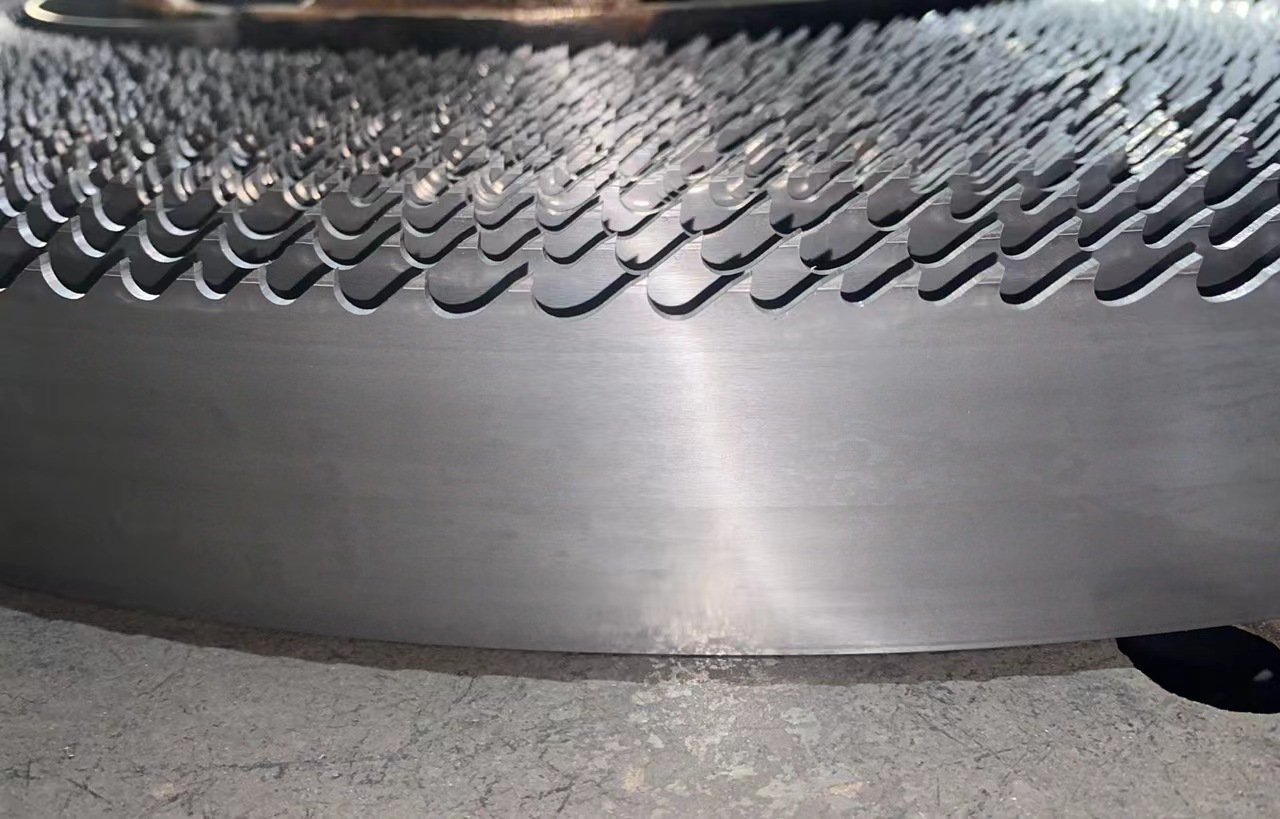
Bi-metal band saw blades in M42 and M51: the general-purpose line for metal cutting. M42 covers carbon and structural steels; M51 is specified for heavy-duty alloy and stainless steel work.
01 / SPECIFICATION
Specification
Product grade
M42 / M51 bi-metal
Available width
27 / 34 / 41 / 54 mm
TPI
1.4/2, 2/3, 3/4, 4/6, 5/8
02 / SUITABLE MATERIALS
Suitable materials
Carbon and structural steels
Alloy steels
Stainless steel (heavy-duty work with M51)
Tube, profile and bundle stock
03 / SUITABLE APPLICATIONS
Suitable applications
Steel service centre and stock-holding cutting
Machinery and parts production
Structural fabrication
Automated sawing cells
04 / KEY BENEFITS
Key benefits
Grade matched to the material rather than to a price point — M42 for general cutting, M51 where the alloy or the section demands it.
Width and tooth pitch selected against the workpiece form and size, not copied from a default list.
Sample or small-batch trials benchmarked against the blade you run today.
One contact from selection through packing and shipment.
It depends on the material and the workload: M42 covers general cutting across structural and carbon steels, while M51 is the choice for heavy-duty alloy and stainless steel cutting. Send the material grade, the workpiece form and the machine, and the choice narrows quickly.
Can I start with a small quantity?
Mixed specifications and small batches are part of normal supply here. The exact quantity depends on the specification and the delivery requirement, so it is confirmed per project rather than stated as a blanket rule.
How do I know the blade is right before ordering volume?
For critical materials or a first order, a sample or small-batch trial is run against the blade in use today, with the observation criteria agreed before the test.
TECHNICAL ADVICE
Bring us the cutting problem.
Material, machine, the blade you run today and what actually goes wrong — that is enough for a first technical answer.